 English (EUR)
 Česky (CZK)
 Deutsch (EUR)
 Polski (EUR)
 Français (EUR)
 Español (EUR)
 Italiano (EUR)
 Română (EUR)
 Ελληνικά (EUR)
 Dutch (EUR)
 Eesti keel (EUR)
 Português (EUR)
 Magyar (EUR)
 Svenska (EUR)
 Dansk (EUR)
 Suomen kieli (EUR)
 български език (EUR)
 Slovenščina (EUR)
 Slovensky (EUR)
 lietuvių kalba (EUR)
 latviešu valoda (EUR)
 Hrvatski (EUR)
THCA: discover the secrets of the ‘mother’ of THC

- What is THCA and how is it formed?
- First records of THCA
- How does THCA work in the body?
- What are the effects of THCA?
- Firefighter
- Protector against degenerative predators
- Other possible effects
- Beware of the dangers of the jungle
- THCA vs. THC
- End of expedition
- FAQ
What is THCA and how is it formed?
THCA is short for tetrahydrocannabinolic acid, a substance that occurs naturally in fresh cannabis 🌿. THCA is produced in trichomes, sticky resin glands found in cannabis flowers, through an enzymatic process from CBGA (cannabigerolic acid).
Tetrahydrocannabinolic acid itself is not intoxicating, but it is a precursor to THC (tetrahydrocannabinol), which is responsible for the psychoactive effects of marijuana.
THC is formed from THCA by decarboxylation, during which the carboxyl group, specifically carbon dioxide, is split off from THCA under the influence of intense or prolonged heat. This means that when THCA is smoked, vaporised, baked, or even just stored for a long time, it turns into THC, which has psychoactive effects.
First records of THCA 🗒️
While THC was first isolated in 1964 by Israeli scientists Raphael Mechoulam, Yehiel Gaoni and their team, the secret of its acidic form, THCA, began to be revealed a little later.
In 1965, German adventurer Friedhelm Korte identified tetrahydrocannabinolic acid in hashish and named it THCA.
A few years later, in 1969, Raphael Mechoulam embarked on another quest to uncover the secrets of THCA. He discovered an acid with the same chemical composition but a different structure — the second isomer of THCA. To distinguish between the two forms, he named the acid discovered by Korte THCA-A and the newly discovered isomer THCA-B.

Since THCA-B is very rare, the term THCA usually refers to the isomer THCA-A, unless explicitly stated otherwise.
The discovery of THCA served as a compass for the first explorers of the cannabis jungle 🧭 — it helped them understand why fresh cannabis does not have the same effect as heated cannabis.
Initially, it was not clear which substances caused the intoxication. The discovery that fresh cannabis contains inactive acids that are converted into active cannabinoids when heated opened the door to further expeditions exploring the medicinal potential of these raw forms, which had been neglected for a long time.
How does THCA work in the body?
How THCA works in the body is still unclear. Cannabinoids in the body primarily act through the endocannabinoid system. This system influences a number of key bodily processes.
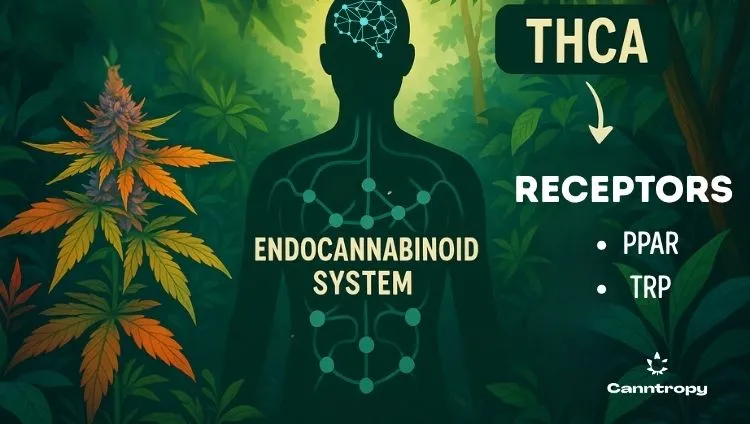
Studies to date suggest that THCA probably does not act directly on the main receptors of this system, but interacts with receptors such as PPAR or TRP, which are closely linked to the endocannabinoid system and contribute to its balance.
THCA also independently of these receptors influences certain bodily processes, such as inflammation.
What are the effects of THCA?
Without altering consciousness, THCA can affect a number of biological processes. Scientists are just beginning to discover what THCA can do, but research to date suggests that this compound has promising potential.
Firefighter 🧯
Inflammation in the body is like a forest fire 🔥 — it causes damage and leaves destruction in its wake. Research suggests that THCA may be able to reduce inflammation.
A study in mice, for example, showed that THCA can suppress inflammatory processes associated with obesity. Other research focusing on intestinal diseases has suggested that THCA could be effective in reducing inflammation in the intestinal mucosa, which could lead to new treatment options for Crohn's disease and other conditions in the future.
Protector against degenerative predators 🐆
The brain, the main research base in the neurological jungle, is constantly under attack from degenerative processes. In tests on mice with symptoms of Alzheimer's disease, THC helped reduce harmful proteins, stabilised brain chemistry and improved memory and learning ability. This could be significant in preventing and slowing the progression of neurodegenerative diseases.
Other possible effects
THCA may also have analgesic and anti-tumour potential. It may also help with nausea, epilepsy, and promote digestion and metabolism. However, these findings are preliminary and more expeditions to THCA are needed to confirm them.
Beware of the pitfalls of the jungle ⚠️
Just as every expedition into the jungle has its pitfalls, the journey to discover THCA is not without risk. Side effects of THCA include nausea and rash.
When THCA is exposed to heat, it converts to THC, which can cause:
- changes in consciousness, euphoria
- hallucinations
- memory and motor problems
- anxiety and paranoia
- increased heart rate
- red eyes
- addiction
THCA vs. THC ⚖️
Chemically speaking, the difference between THCA and THC may seem negligible: THCA has only one extra carboxyl group. However, it is precisely because of this group that it is unable to bind to CB1 receptors in the brain, and therefore has different effects and is not psychoactive.
|
|
THCA |
THC |
|
Form |
Inactive |
Active |
|
Psychoactivity |
non-psychoactive |
Psychoactive |
|
The emergence of |
is produced in a fresh plant from CBGA |
formed by heating/aging of THCA |
|
Effects |
possible anti-inflammatory and neuroprotective effects |
pain relief, appetite stimulation, anti-inflammatory and neuroprotective effects |
|
Side effects |
nausea, rash, possible conversion to THC |
changes in perception, hallucinations, memory and motor problems, anxiety and paranoia |
|
Legal status |
usually unregulated, unclear legal status |
usually strictly regulated or completely prohibited |
End of the expedition
Although we have reached the end of the article, the jungle expedition is not over — THCA still hides many unanswered questions that brave researchers are already seeking answers to 🌴.
We already know that the role of THCA may not be purely passive, and that in addition to serving as a raw material for the formation of THC, it has properties that may play an important role in the future of natural medicine. These include, for example, potential anti-inflammatory, neuroprotective, analgesic and anti-tumour effects, effects on digestion and metabolism, and possible help with epilepsy.
On its own, THCA is not psychoactive, unlike THC, but it can be converted to THC when heated.
FAQ
1. In what forms is THCA used?
THCA is used orally or topically, with emphasis on avoiding unwanted heating and conversion to THC — therefore, the easiest way to consume it is by eating raw cannabis.
It can be juiced or blended into a smoothie, for example.
However, you can also find a whole range of THCA products in the cannabis jungle — from isolates to THCA flowers to vapes. If you decide to try the effects of THCA, always keep safety and legality in mind and buy products from reputable manufacturers.
2. Can THCA affect my consciousness?
Will THCA get you high? If you want to stay safe on your expeditions through the cannabis jungle, you need to know how to avoid its pitfalls. THCA itself does not pose a danger to your consciousness, but with heat and time, it can convert to THC, which is psychoactive.
The safest way to minimise the risk of intoxication is to consume THCA from fresh cannabis 🌿.
3. Is THCA legal?
THCA currently has an unclear legal status in most countries. If you want to purchase and consume THCA, always check the current legislation in your country.
4. Will THCA show up in a drug test?
THCA is not usually detected by standard drug tests. However, when heated (e.g. when vaporised), it converts to THC, which is detected by drug tests. In addition, THCA products may contain trace amounts of THC, which may show up in tests.
5. How long does THCA stay in the body?
How long THCA stays in the body depends on many factors, such as:
- frequency of use
- age
- metabolism
- body fat percentage
- lifestyle
If you use THCA frequently, are older, have a slower metabolism, a high body fat percentage, and do not lead an active lifestyle, THCA is likely to remain in your body longer than in younger individuals with a fast metabolism.
Sources:
- The biosynthesis of the cannabinoids - PMC
- Unheated Cannabis sativa extracts and its major compound THC-acid have potential immuno-modulating properties not mediated by CB1 and CB2 receptor coupled pathways - PubMed
- Tetrahydrocannabinolic acid A (THCA-A) reduces adiposity and prevents metabolic disease caused by diet-induced obesity - PubMed
- Anti-Inflammatory Activity in Colon Models Is Derived from Δ9-Tetrahydrocannabinolic Acid That Interacts with Additional Compounds in Cannabis Extracts - PMC
- The Cannabinoids, CBDA and THCA, Rescue Memory Deficits and Reduce Amyloid-Beta and Tau Pathology in an Alzheimer's Disease-like Mouse Model - PubMed
- Dosing THCA: Less Is More - Project CBD
- What Is THCA? - WebMD
- Can You Pass the Acid Test? Critical Review and Novel Therapeutic Perspectives of Δ9-Tetrahydrocannabinolic Acid A - PMC
- How long does THCA Stay in Your System? - The Edge Treatment Center
Author: Natálie Kubíčková
Photo: AI
"All information provided on this website, as well as information provided through this website, is for educational purposes only. None of the information contained herein is intended as a substitute for medical diagnosis and such information should not be considered medical advice or recommended treatment. This website does not promote, endorse or advocate the legal or illegal use of narcotic drugs or psychotropic substances or the commission of any other illegal activity. Please see our Disclaimer for further information."
Recommended products4

Canntropy Sticker

Canntropy Sticker

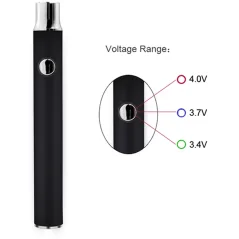
Canna b2b 510 thread battery, button, pre-heat, 1100 mAh + USB charger